Old
The lighthouse
The oldest landmark
See the day toursHelp with your choice
Two questions, one tour
Say which part of the history interests you and how you like to travel, and a tour appears with its starting price.
Recommended for you
from $41
A day from Montevideo with a Casapueblo stop of 35 minutes and free time in town.
Recommended for you
from $10
A walk from the port past the lighthouse and the Hand sculpture.
Recommended for you
from $50
A drive with pickup at a town hotel around the peninsula and the coast.
The meaning of the name Punta del Este and the story behind it, from the explorers and sealers to the 1907 town law, the lighthouse and today's resort.
Editorial team, puntadelestedaytrip.click · Updated November 12, 2026 · Takes 7 min
The meaning of the name is plain Spanish. A punta is a point or headland and este is east, so Punta del Este is East Point, a name for the peninsula that juts out at the eastern edge of the Bay of Maldonado. The name describes the shape of the land, a tongue of rock and sand pointing into the water with the bay on a side and the open ocean on the other. For a visitor it is the easiest name to remember and to place: a point, to the east, between a bay and an ocean.
The official name has not always been the everyday name. The Intendencia de Maldonado says that on 5 July 1907 President Claudio Williman promulgated Law 3186, which created the town of Punta del Este, initially called Villa Ituzaingo.1 In other words, the town was legally created under a different name, and today only the plain geographical name survives.
If you ask what the name tells a traveler, the answer is mostly about location: a point of land at the meeting of the river and the ocean. The ministry describes the Mansa and Brava beaches as the place where the estuary stops and the Atlantic starts.4 That is why the point matters on a map, and why sailors have long used it as a landmark.
Key dates
| When | What happened | Where to see it |
|---|---|---|
| 1516 | Solis discovers the port5 | The port |
| 1860 | The lighthouse begins to work2 | The old town |
| 1907 | Law 3186 creates the town1 | The peninsula |
| 1910 | The British House hotel opens7 | The old town |
| 1924 | The yacht club is founded8 | The port |
| 1982 | The Hand rises on Playa Brava3 | Playa Brava |
Dates from the Intendencia de Maldonado and its English leaflet; places are for orientation.
The coast had a long history before tourism. The Intendencia says the port, named for Our Lady of the Candelaria, was discovered on 2 February 1516 by the navigator Juan Diaz de Solis, on the feast day of that name.5 The department's capital, Maldonado, took shape later: the Intendencia's history page records that in 1755 the founding families were settled near the Laguna del Diario.6
The sea gave the region its economy. The department's original coat of arms of 1778 carried a sea lion, and a whale joined it from 1803, when whaling was growing.9 From 1820 a local shipowner could hunt seals under a concession covering Isla de Lobos and the Rocha shore,10 and the environment ministry calls the island a strategic outpost of colonial whaling and sealing since the 18th century.11
The same waters were dangerous. The ministry records shipwrecks around Isla de Lobos since 1795, which led to a lighthouse there in 1858, rebuilt in 1906.12 The naturalist Charles Darwin stayed in the area for 10 weeks in 1833, according to the Intendencia's page on the museum of Maldonado,13 so the bay was already known to visiting scientists long before any hotel.
The town as a legal place dates from 1907.1 In its news item for the anniversary, the Intendencia says the peninsula was given town status, taking into account that it already had a definitive subdivision made by the surveyor Francisco Surroca.24 That detail matters because it shows the land had been surveyed and divided into plots before the law arrived,
Williman is also remembered for the road that linked Punta del Este with Maldonado and eased the arrival of tourists, according to the Intendencia.25 A road changes everything for a place at the end of a peninsula, because visitors no longer depend on boats. The oldest summer residences, in the architectural styles of the early last century, stand around the lighthouse in what the Intendencia calls the most historic site of the resort.18
The lighthouse had already been working for decades. The English leaflet of the Intendencia says it was built by Tomas Libarena and started working on November 17th, 1860, and the Intendencia's tourist page says it has been in service since 1860.2,26 It stands 45 metres high.17 That makes the lighthouse older than the town itself, and the best place to start a walk through the history of the resort.
Compare the symbols
Old
The oldest landmark
See the day tours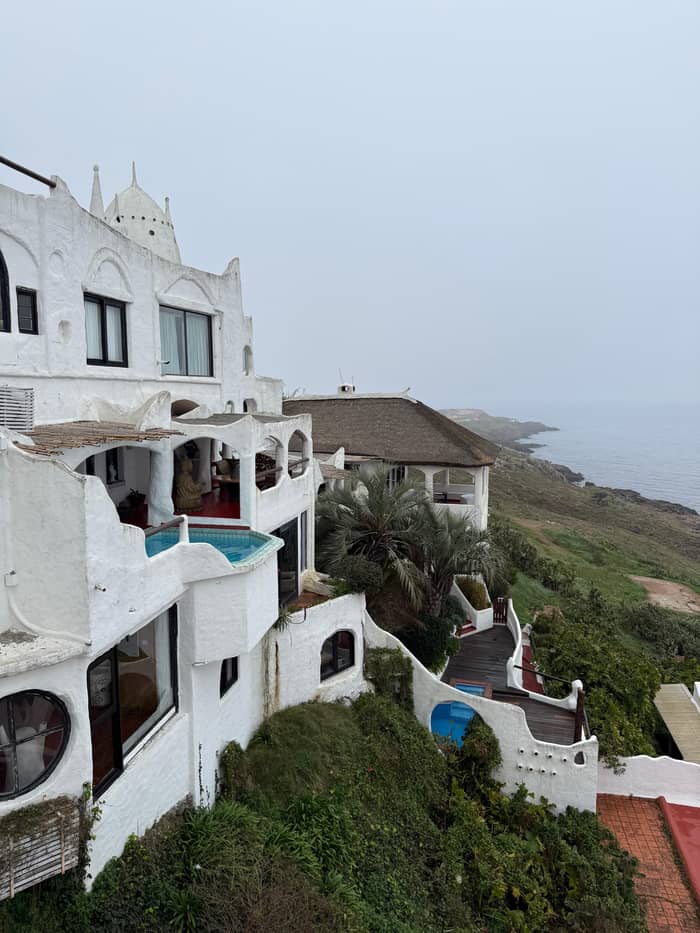
Modern
The photo icon
See the day tours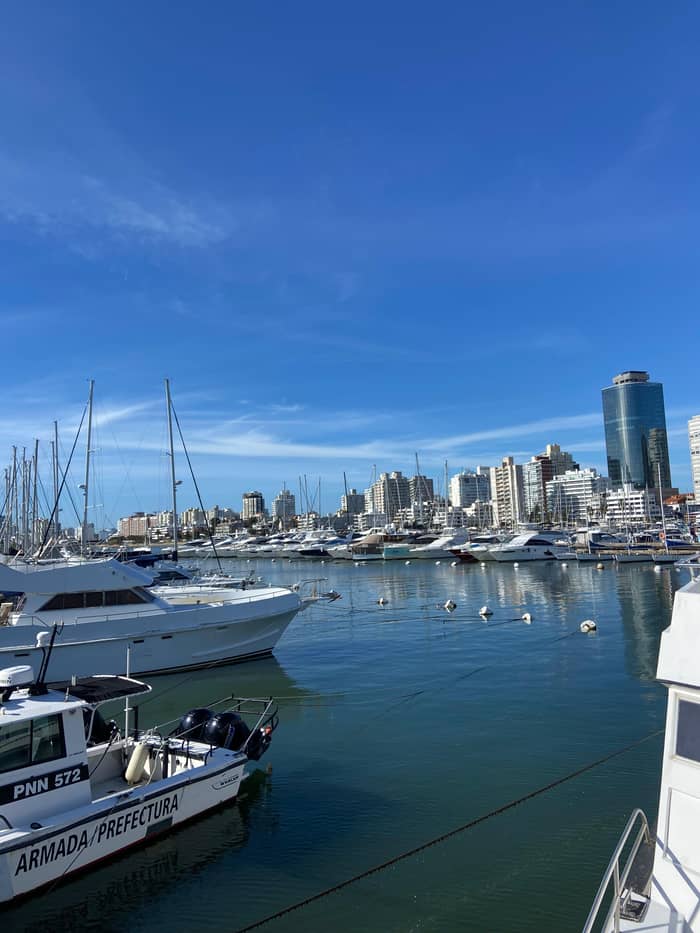
Art
The cliff-top house
See the day toursAfter the road existed, hotels followed. The Intendencia says the British House hotel opened in 1910 and the Gran Hotel Espana a year later.7 The Yacht Club Punta del Este was founded on 14 February 1924, according to the same news item, a milestone in the development of the young resort.8 These buildings and clubs are what give the peninsula its seaside-town character today.
Later milestones show how the resort grew up. The Intendencia says Punta del Este was the first destination recognized by the World Tourism Organization for the quality of its visitor services.30 A sculpture by Pablo Atchugarry commemorates the centennial of Punta del Este,23 and the English leaflet lists it among the stops of the walking circuit.31
The port is part of the modern story. The head of the port expects 44 cruise calls in the coming season, from 8 December to 3 April.32 a leaflet adds that the cruise pier called La Pastora was prepared for visiting ships,33 and the department around the resort is the fastest growing in Uruguay, mainly through migration.34 The resort that began with a lighthouse now handles ships, residents and visitors every year.
See it with a guide
Set the group size to see what a guided look at the history would cost.
Side-by-side: 4 options
Set the group size to see what a guided look at the history would cost.
≈
View≈
View≈
View≈
ViewCurrency conversion uses the ECB reference rate on GetYourGuide from-prices. The exact price is displayed when you book.
Dates that shaped the place
Discovery
Solis discovered the port on 2 February 1516.5
Sealers and settlers
The first founding families settled near the Laguna del Diario in 1755.6
Lighthouse
The lighthouse started working on 17 November 1860.2
Town status
Law 3186 created the town on 5 July 1907.1
Resort years
British House opened in 1910 and the yacht club was founded in 1924.7,8
Sculpture
It rose on Playa Brava in 1982.3
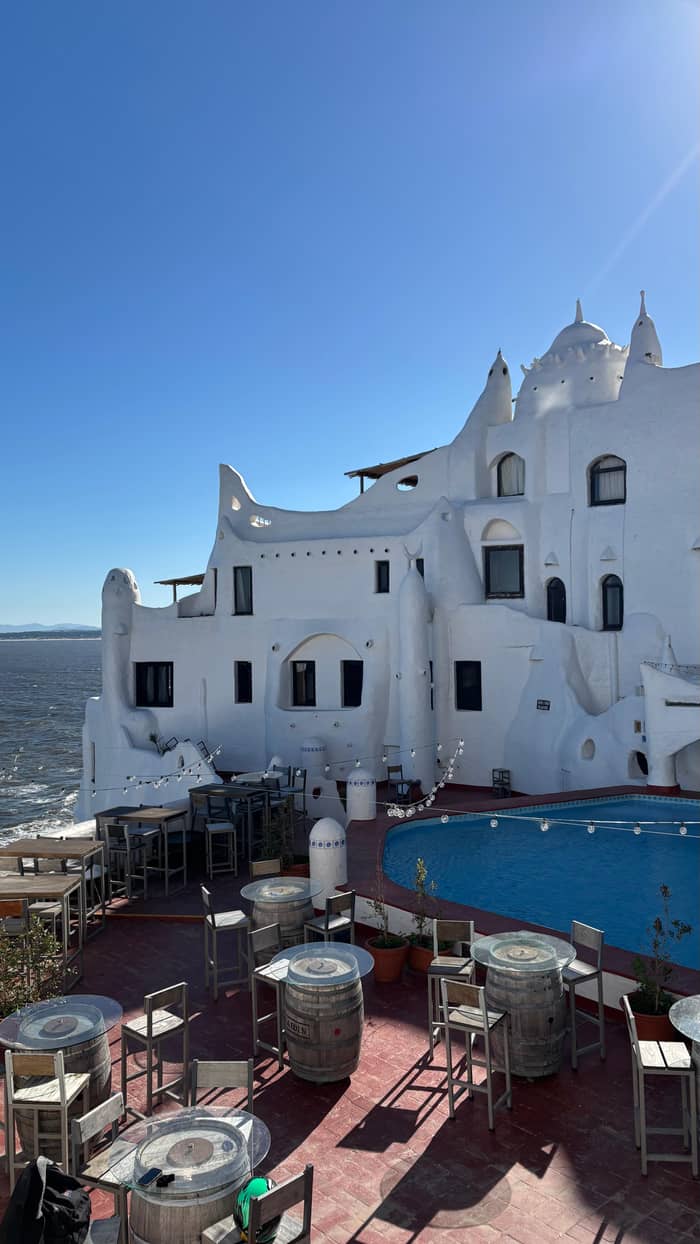
Art defines the resort's modern image. The National Museum of Visual Arts says that in 1958 Carlos Paez Vilaro began to build Casapueblo, a habitable sculpture that became his home, workshop, hotel and museum.21 The Intendencia presents it as the artist's masterpiece, an emblem of the country's architecture.22
The Hand is a younger symbol. The Intendencia says it rose on Playa Brava in 1982, after an international gathering of open-air sculptors,3 with 9 sculptors from several countries taking part.35 Mario Irarrazabal, a Chilean sculptor, picked the spot and completed the piece within 6 days,19 and it was declared a Good of Heritage Interest in 2019.20
Together they bracket the story: a house begun in 1958 on a cliff by an artist,21 and a sculpture that grew from an international competition in 1982 on the Paseo de las Americas.36 Both can be seen from outside, both are easy to reach from the peninsula, and both are the reason many visitors remember Punta del Este as a place of art as much as of beaches.
Video
DW News on YouTube · The video waits until you tap play to load.
This sculpture by Pablo Atchugarry is to commemorate Punta del Este’s centennial.
Walk the history
A short list of Punta del Este facts helps put the story in order: the town law is from 1907,1 the lighthouse from 1860,26 the Hand from 1982.3 The national statistics institute counts 20,600 residents in the municipality and 17,436 in the locality proper, using weighted May 2026 data.15,14 These are the fixed points that the rest of this page hangs from, so it is worth knowing them before you read on.
The coast is long: the ministry's pages measure the coast at more than 20 km, with hills facing the sea.37 Gorriti, the nearer island, lies 2 km out,38 and Isla de Lobos about 8 km from the coast, inside a national park of 40 square kilometers that includes the sea around it.39,40 The harbor has 400 mooring lines,41 and Calle 20 is a shopping street of 7 blocks.42
Those numbers also tell you what to look for on the ground. The lighthouse is 45 metres high,17 the Hand sculpture is the work of 6 days,19 and the whale season runs from July to October.43 If you use the table and chart below, you will see the whole history in a glance, and you can use it as a checklist when you walk the peninsula. Treat the dates as the fixed points of the story; the sections above explain each of them in turn.
People searching for Punta del Este size usually want a figure, but the official pages give measures of different kinds instead. In people, the municipality counts 20,600 and the locality 17,436.15,14 The department of Maldonado had 212,954 people at the 2023 census, against 172,130 in 2011.16 The national statistics institute says Maldonado was the fastest growing department in Uruguay.34
In distances, the resort is compact. The department lies 130 km from Montevideo,44 and the department's coast runs more than 100 km from Balneario Solis to Jose Ignacio.45 The peninsula itself is small enough to walk in a morning, and the leaflet's circuit connects its main stops on foot.28 With a lighthouse at the tip and the harbor on the bay side, a walk around the peninsula is the best measure of size for a visitor: a morning, with stops for photographs and a coffee.
The islands add their own sizes. Isla de Lobos covers 43.5 hectares and its islet 1.3 hectares,46 while Isla Gorriti has 21 hectares by the Intendencia's count and 22 in the leaflet.47,48 None of these are large, and that is the point: the resort's fame comes from its position and its beaches, not from its area. Use the next page on things to do to turn the map into a plan.
FAQ
It names a point of land at the east of the Bay of Maldonado; the 1907 law created the town under that name.1
President Williman promulgated Law 3186 on 5 July 1907, creating the town.1
The Intendencia says the town was initially called Villa Ituzaingo before the name changed.1
The Intendencia says the navigator discovered it on 2 February 1516.5
It rose on Playa Brava after an international meeting of sculptors.3
He began building it in 1958, according to the National Museum of Visual Arts.21
Sources
Also worth reading
Heading to Punta del Este? Ask a real person here.